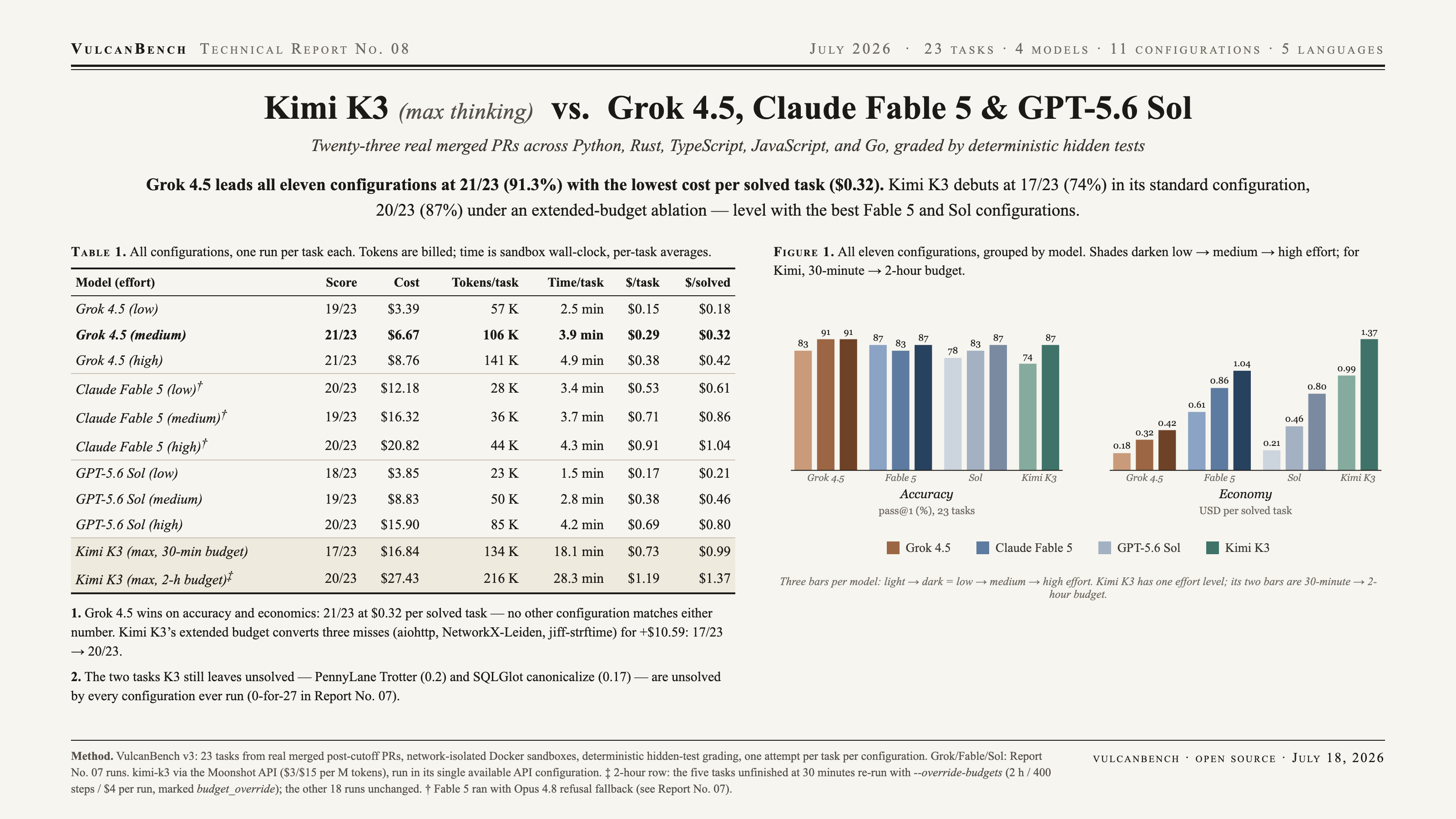
Grok 4.5 leads all eleven configurations at 21/23 (91.3%) with the lowest cost per solved task ($0.32). Kimi K3 debuts at 17/23 (74%) in its standard configuration and 20/23 (87%) under an extended-budget ablation, level with the best Fable 5 and Sol configurations. The two hardest v3 tasks remain unsolved by every model.
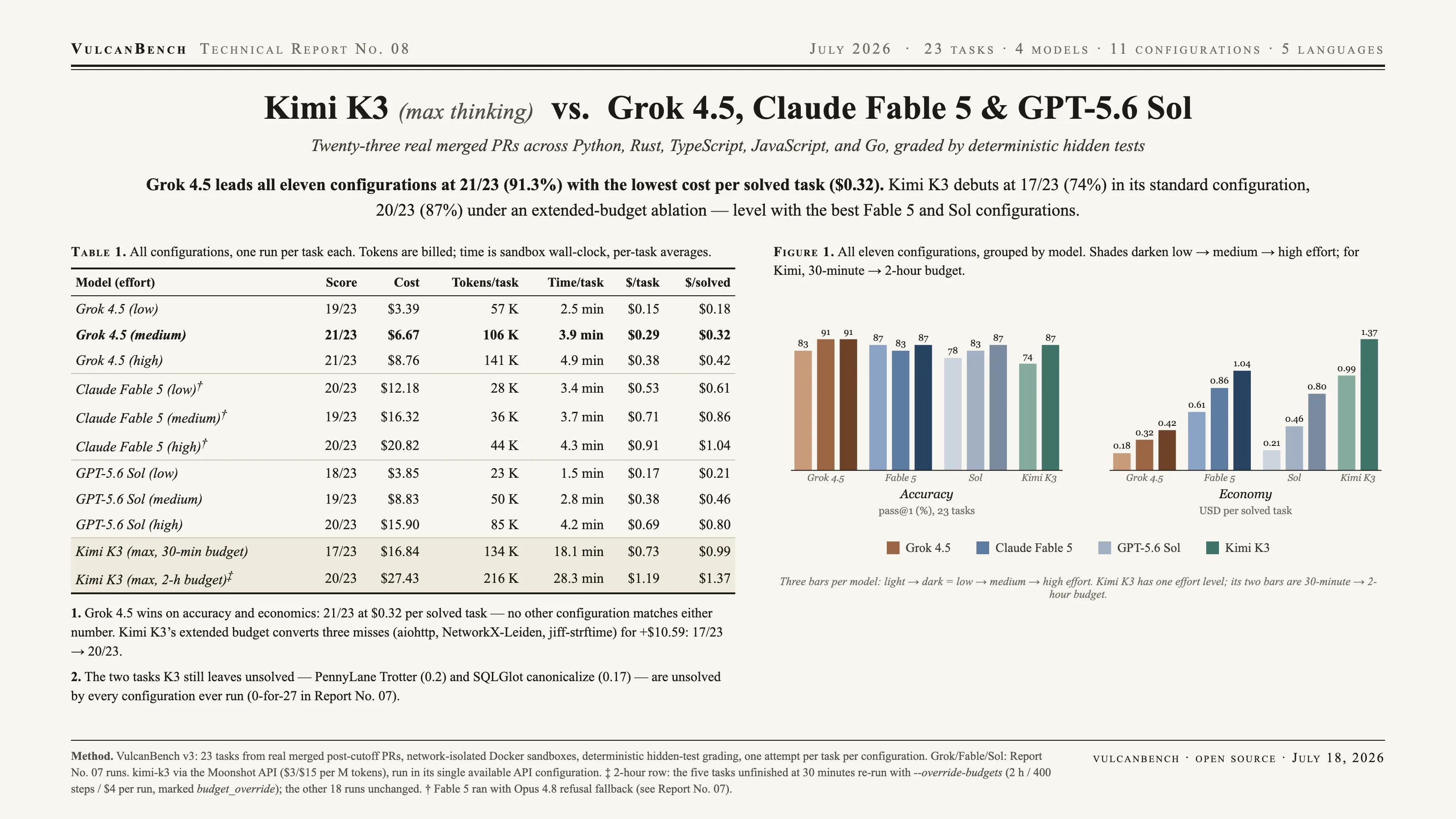
| Model (effort) | Score | pass@1 | Cost | Tokens/task | Time/task | $/solved |
|---|---|---|---|---|---|---|
| Grok 4.5 (medium) | 21/23 | 91.3% | $6.67 | 106 K | 3.9 min | $0.32 |
| Grok 4.5 (high) | 21/23 | 91.3% | $8.76 | 141 K | 4.9 min | $0.42 |
| Claude Fable 5 (low)† | 20/23 | 87.0% | $12.18 | 28 K | 3.4 min | $0.61 |
| GPT-5.6 Sol (high) | 20/23 | 87.0% | $15.90 | 85 K | 4.2 min | $0.80 |
| Claude Fable 5 (high)† | 20/23 | 87.0% | $20.82 | 44 K | 4.3 min | $1.04 |
| Kimi K3 (max, 2-h budget)‡ | 20/23 | 87.0% | $27.43 | 216 K | 28.3 min | $1.37 |
| Grok 4.5 (low) | 19/23 | 82.6% | $3.39 | 57 K | 2.5 min | $0.18 |
| GPT-5.6 Sol (medium) | 19/23 | 82.6% | $8.83 | 50 K | 2.8 min | $0.46 |
| Claude Fable 5 (medium)† | 19/23 | 82.6% | $16.32 | 36 K | 3.7 min | $0.86 |
| GPT-5.6 Sol (low) | 18/23 | 78.3% | $3.85 | 23 K | 1.5 min | $0.21 |
| Kimi K3 (max, 30-min budget) | 17/23 | 73.9% | $16.84 | 134 K | 18.1 min | $0.99 |
‡ 2-hour row: the five tasks that did not finish within the 30-minute budget were re-run with exact budgets of 2 h / 400 steps / $4 per run (runs marked budget_override); the other 18 runs are unchanged. It is an ablation, not a leaderboard config: every other model ran under the standard budget. † Fable 5 ran with Opus 4.8 refusal fallback (see Report 07). Grok/Fable/Sol rows reproduced from Report 07. Tokens are billed tokens; time is sandbox wall-clock.
Grok 4.5 wins on accuracy and economics. 21/23 (91.3%) at $0.32 per solved task: no other configuration matches either number. Its medium and high efforts tie, keeping medium the efficiency frontier of the board.
Kimi K3 debuts mid-pack and closes with budget. 17/23 in its standard configuration; the extended-budget ablation converts aiohttp, NetworkX-Leiden, and jiff-strftime for +$10.59, reaching 20/23, matching the best Fable 5 and Sol configurations.
The v3 difficulty ceiling held. PennyLane Trotter fragmentation (0.2 partial) and SQLGlot internal-name canonicalization (0.17 partial) remain unsolved by every configuration ever run: 0-for-27 in Report 07, and K3’s extended attempts didn’t crack them either.
| Task | 30-min budget | 2-h budget | Time | Cost |
|---|---|---|---|---|
| aiohttp-upgrade-deferred | × did not finish | ✓ solved | 64 min | $2.66 |
| networkx-leiden-communities | × did not finish | ✓ solved | 107 min | $4.35 |
| jiff-strftime-negpad | × did not finish | ✓ solved | 21 min | $1.14 |
| pennylane-trotter-fragmented | × did not finish | partial (0.2), $4 cap | 100 min | $4.78 |
| sqlglot-canonicalize-internal-names | × did not finish | partial (0.17), $4 cap | 94 min | $4.12 |
| sqlglot-iso8601-nanos | partial (0.7) | , not re-run | , | , |
The two remaining tasks ended at the $4 per-run cost cap with partial progress.
Same 23 v3 tasks as Report 07 (real merged post-cutoff PRs across Python, Rust, TypeScript, JavaScript, Go), graded by deterministic hidden tests in a network-isolated Docker sandbox, one attempt per task per configuration. kimi-k3 via the Moonshot API ($3 / $15 per million tokens, cache-hit input billed here at the cache-miss rate), run in its single available API configuration. The extended-budget ablation used the --override-budgets flag, which stamps runs so they cannot be mixed into standard comparisons.