
With its code now judged, Muse Wonder Full scores 87.0 on the combined score at Low, 88.3 at Medium, 88.2 at High, 87.4 at Extra-high and 88.4 at Max. It is level with the frontier at Low and second at Medium, but it does not gain from more effort: the other three climb at higher levels, it is fourth at Extra-high, and Max, added on 4 November, brings it back only to Medium’s level. It is also the slowest of the four at every level, at about 27 to 41 minutes per task, and the most expensive at every level but Max, at about $4 to $6.
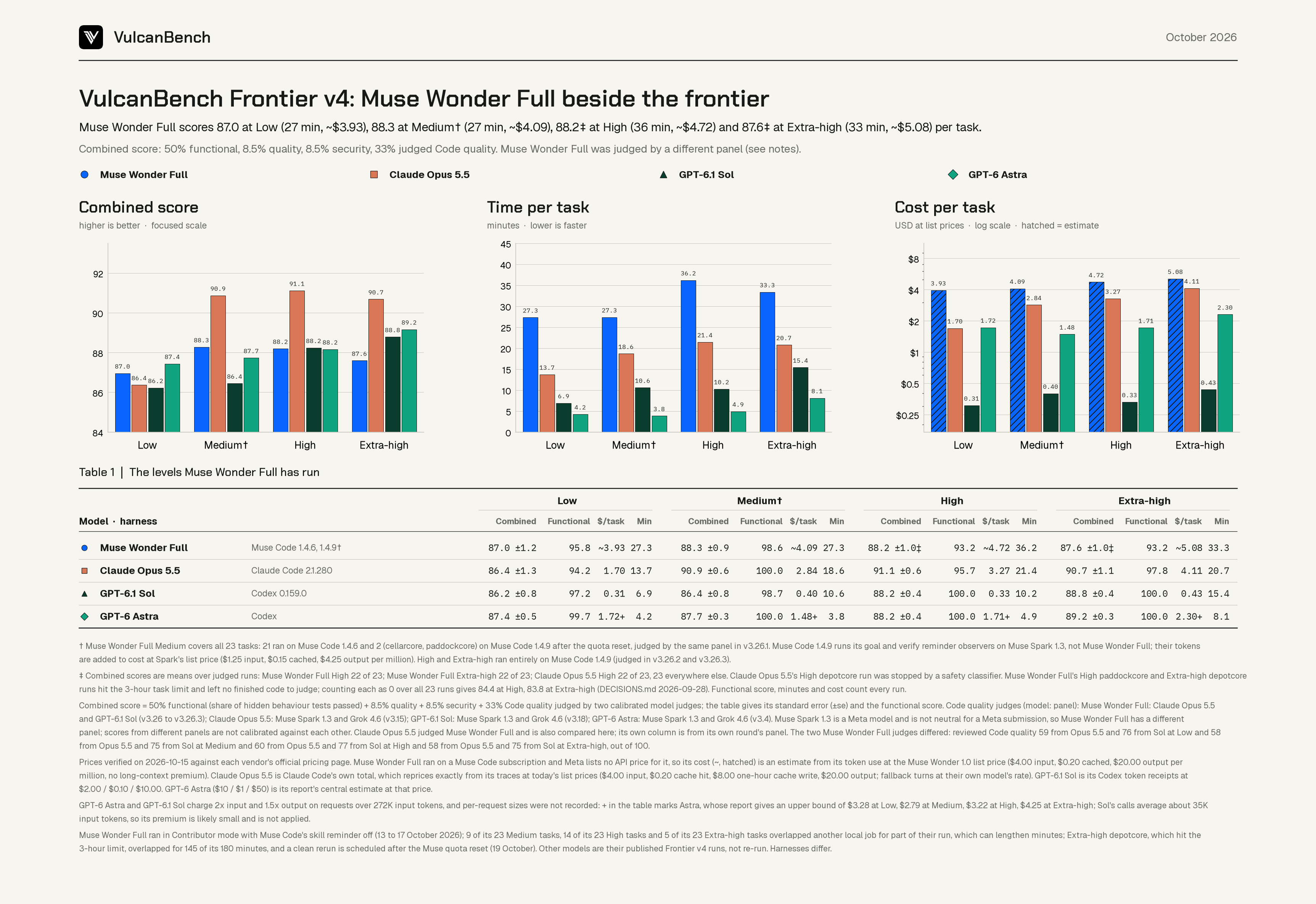
The numbers
Means per task over every run, one run per task and level. The combined score is 50% functional score (the share of hidden behavior tests passed), 8.5% quality, 8.5% security and 33% judged Code quality, with its standard error.
| Low | Medium† | High | Extra-high | Max | ||||||||||||||||
|---|---|---|---|---|---|---|---|---|---|---|---|---|---|---|---|---|---|---|---|---|
| Model | Combined | Functional | Min | $/task | Combined | Functional | Min | $/task | Combined | Functional | Min | $/task | Combined | Functional | Min | $/task | Combined | Functional | Min | $/task |
| Muse Wonder Full | 87.0 ±1.2 | 95.8 | 27.3 | ~3.93 | 88.3 ±0.9 | 98.6 | 27.3 | ~4.09 | 88.2 ±1.0‡ | 93.2 | 36.2 | ~4.72 | 87.4 ±1.0 | 97.5 | 30.3 | ~4.86 | 88.4 ±0.8 | 99.0 | 40.9 | ~5.91 |
| Claude Opus 5.5 | 86.4 ±1.3 | 94.2 | 13.7 | 1.70 | 90.9 ±0.6 | 100.0 | 18.6 | 2.84 | 91.1 ±0.6‡ | 95.7 | 21.4 | 3.27 | 90.7 ±1.1 | 97.8 | 20.7 | 4.11 | 90.2 ±1.0 | 97.2 | 37.5 | 8.75 |
| GPT-6.1 Sol | 86.2 ±0.8 | 97.2 | 6.9 | 0.31 | 86.4 ±0.8 | 98.7 | 10.6 | 0.40 | 88.2 ±0.4 | 100.0 | 10.2 | 0.33 | 88.8 ±0.4 | 100.0 | 15.4 | 0.43 | 88.3 ±0.3 | 100.0 | 14.5 | 0.46 |
| GPT-6 Astra | 87.4 ±0.5 | 99.7 | 4.2 | 1.72+ | 87.7 ±0.3 | 100.0 | 3.8 | 1.48+ | 88.2 ±0.4 | 100.0 | 4.9 | 1.71+ | 89.2 ±0.3 | 100.0 | 8.1 | 2.30+ | 89.3 ±0.4 | 100.0 | 10.3 | 2.57+ |
Every cell covers 23 runs. † Muse Wonder Full's Medium ran 21 tasks on Muse Code 1.4.6 and the last 2 (cellarcore, paddockcore) on 1.4.9, after the Muse Code quota reset; its High, Extra-high and Max ran entirely on 1.4.9. ‡ Combined over 22 judged runs: Muse Wonder Full's High paddockcore run hit the 3-hour task limit and left no finished code to judge (84.4 with it counted as 0 over all 23), and Claude Opus 5.5's High depotcore run was stopped by a safety classifier. Muse Wonder Full's Extra-high depotcore is its clean rerun of 19 October, which replaces a run that timed out while another job shared the machine. Functional score, minutes and cost count every run. Data: frontier-comparison.csv.
Combined score
- Low: a four-way tie. All four models are within 1.2 points (86.2 to 87.4), and the standard errors are 0.5 to 1.3 points, so no order at Low is reliable. Muse Wonder Full's 87.0 sits between Astra's 87.4 and Opus 5.5's 86.4.
- Medium: second. Muse Wonder Full's 88.3 is behind Opus 5.5's 90.9, just ahead of Astra (87.7, within the standard errors) and ahead of GPT-6.1 Sol (86.4).
- High: level with GPT-6.1 Sol and Astra. Muse Wonder Full's 88.2 matches GPT-6.1 Sol (88.2) and Astra (88.2), behind Opus 5.5's 91.1. That is over 22 judged runs: paddockcore hit the 3-hour limit, and counting it as 0 gives 84.4.
- Extra-high: fourth. Muse Wonder Full's 87.4 is behind Opus 5.5 (90.7), Astra (89.2) and GPT-6.1 Sol (88.8), over all 23 runs. Until 4 November this was 87.6 over 22 judged runs, with depotcore's first run timed out beside another job; its clean rerun passed every hidden test but scored 82.2, with a Code quality of 55.2 against the level's mean of 71.1.
- Max: third, level with GPT-6.1 Sol. Muse Wonder Full's 88.4 is behind Opus 5.5 (90.2) and Astra (89.3) and level with GPT-6.1 Sol (88.3), over all 23 runs with no timeout.
- No gain from more effort. Muse Wonder Full reaches 88.3 at Medium and then holds or slips (88.2, 87.4) before Max returns it to 88.4, within 0.1 of Medium, while GPT-6.1 Sol rises from 86.2 to 88.8 and Astra from 87.4 to 89.3. Its one timeout came at High.
- Functional score. Muse Wonder Full passed 95.8% of hidden tests at Low (18 of 23 tasks fully solved), 98.6% at Medium (21 of 23), 93.2% at High (19 of 23, with the timeout as a failure), 97.5% at Extra-high (20 of 23) and 99.0% at Max (22 of 23, its best).
Time and cost
- Time. At Low, Muse Wonder Full takes 27.3 minutes per task: about 2x Opus 5.5, 4x GPT-6.1 Sol and 6.5x Astra. At Medium it takes 27.3 minutes: about 1.5x Opus 5.5 (18.6), 2.6x GPT-6.1 Sol (10.6) and 7x Astra (3.8). At High it takes 36.2 minutes on average (median 24.0), raised by depotcore (111 minutes) and the paddockcore timeout (180): about 1.7x Opus 5.5 (21.4), 3.5x GPT-6.1 Sol (10.2) and 7x Astra (4.9). At Extra-high it takes 30.3 minutes (median 24.1): about 1.5x Opus 5.5 (20.7), 2x GPT-6.1 Sol (15.4) and 3.7x Astra (8.1). At Max it takes 40.9 minutes (median 30.7) with no timeout: about 1.1x Opus 5.5 (37.5), 2.8x GPT-6.1 Sol (14.5) and 4x Astra (10.3). Analysis No. 01 traces where that time goes: about 3x more model calls and 10x more output than GPT-6.1 Sol, not slower steps.
- Cost. About $3.93 per task at Low, $4.09 at Medium, $4.72 at High, $4.86 at Extra-high and $5.91 at Max: about 2.3x Opus 5.5 and Astra at Low, 1.2x to 1.4x Opus 5.5 and 2.1x to 2.8x Astra from Medium to Extra-high, and about 10x to 14x GPT-6.1 Sol throughout. At Max it is cheaper than Opus 5.5 ($8.75, about two thirds of it) and 2.3x Astra. Meta lists no API price for Muse Wonder Full, so this is an estimate from its token use at the Muse Wonder 1.0 list price ($4.00 input, $0.20 cached, $20.00 output per million tokens).
- Value. At Low, GPT-6.1 Sol reaches about the same combined score for about a twelfth of the cost and a quarter of the time. At Medium, Muse Wonder Full's extra 1.8 points over Sol cost about ten times as much per task. At High the two tie at 88.2, and Sol costs about a fourteenth as much. At Extra-high Sol scores 1.4 points more for about an eleventh of the cost. At Max the two tie again (88.4 and 88.3), and Sol costs about a thirteenth as much.
How the code was judged
Code quality is a third of the combined score, and two calibrated model judges score it. Each judge first passes an exam on held-out code samples under the same frozen protocol. The other three models were judged by Muse Spark 1.3 and Grok 4.6. Muse Spark is a Meta model, so it is not neutral for a Meta model, and Muse Wonder Full was judged by Claude Opus 5.5 and GPT-6.1 Sol instead. Both passed the exam with no failing gate.
- Different panels. Scores from different judge panels are not calibrated against each other, so small gaps between Muse Wonder Full and the others should be read with care.
- The two judges disagreed. Reviewed Code quality was 59 from Opus 5.5 and 76 from GPT-6.1 Sol at Low, 58 and 75 at Medium, 60 and 77 at High, 57 and 74 at Extra-high, and 57 and 75 at Max, out of 100. The combined score uses their mean. Scored by one judge alone, Muse Wonder Full's combined score would be 85.0 (Opus 5.5) or 88.9 (GPT-6.1 Sol) at Low, 86.2 or 90.3 at Medium, 86.1 or 90.2 at High, 85.5 or 89.2 at Extra-high, and 86.2 or 90.5 at Max.
- A judge that is also compared. Claude Opus 5.5 judged Muse Wonder Full and also appears in this comparison. Its own combined score comes from its own round, judged by Muse Spark 1.3 and Grok 4.6.
Method and caveats
Runs. Muse Wonder Full (muse-wonder-full-1.0, Contributor mode) with its skill reminder off, at Low (23 tasks, 13 to 14 October 2026, Muse Code 1.4.6) and Medium (23 tasks: 21 on Muse Code 1.4.6, 14 to 15 October, and the last 2 on Muse Code 1.4.9, 16 October) High (23 tasks on Muse Code 1.4.9, 16 to 17 October), Extra-high (23 tasks on Muse Code 1.4.9, 17 October, with depotcore rerun on 19 October) and Max (23 tasks on Muse Code 1.4.9, 3 to 4 November). Meta documents Max as Standard-only for Muse Spark and says nothing about it for Muse Wonder Full in Contributor mode, so it was first left out; a probe on 3 November showed Contributor mode honors it (more than twice Extra-high's reasoning on the same puzzle), and it was run. The Muse Code weekly limit stopped Medium at 21 tasks; after Meta reset the quota and released a more token-efficient Muse Code, the last two and every later level ran on 1.4.9. One High attempt (snapcore) lost its connection to Meta's API partway through; it was unscored and the task was rerun. Muse Code 1.4.9 runs its end-of-run goal and verify reminder observers on Muse Spark 1.3, not on the main model as 1.4.6 did; those calls are recorded apart, and every other call was Muse Wonder Full. The other models are their published Frontier v4 runs: Claude Opus 5.5 in Claude Code 2.1.280, GPT-6.1 Sol in Codex 0.159.0 and GPT-6 Astra in Codex.
Judging. Muse Wonder Full's Code quality is protocol v3.26 (Claude Opus 5.5 at medium effort) with GPT-6.1 Sol's v3.25 scores (medium effort) on byte-identical inputs, the v3.26.1 top-up for the two 1.4.9 Medium runs, v3.26.2 for High, v3.26.3 for Extra-high, v3.26.4 for the Extra-high depotcore rerun and v3.26.5 for Max, judged by the same two judges with no new exam (each is another level of the same sweep). Opus 5.5 is v3.15, GPT-6.1 Sol v3.18 and GPT-6 Astra v3.4.
Cost. List prices were checked on 15 October 2026, and Muse Spark 1.3's on 16 October. The Spark reminder tokens of the 1.4.9 runs are added to Muse Wonder Full's cost at Spark's list price ($1.25 input, $0.15 cached, $4.25 output per million). Opus 5.5 is Claude Code's own total, which reprices exactly from its traces. GPT-6.1 Sol is its Codex token receipts at $2.00 / $0.10 / $10.00 per million. GPT-6 Astra ($10 / $1 / $50) is its report's central estimate; it and GPT-6.1 Sol charge more on requests over 272K input tokens, and request sizes were not recorded, so + marks Astra's upper bound ($3.28 at Low, $2.79 at Medium, $3.22 at High, $4.25 at Extra-high, $4.69 at Max). GPT-6.1 Sol's calls average about 35K input tokens, so its premium is likely small.
Not controlled. The harnesses differ, and minutes are wall-clock time in each model's own harness. Nine of Muse Wonder Full's 23 Medium tasks, 14 of its 23 High tasks and 4 of its 23 Extra-high tasks overlapped another local job for part of their run, which can lengthen minutes; Max ran alone. Extra-high depotcore first hit the 3-hour limit with 145 of its 180 minutes overlapped (it finished clean at High in 111 minutes), so it was rerun alone on 19 October (109 minutes, every hidden test passed), and the judged rerun replaces it; one GPT-6.1 Sol call in that round stopped on a Codex reconnect and was rerun once with identical inputs on 4 November. One run per task and level, except that depotcore rerun.