
November 24, 2026 · Morgan Linton · 115 runs · Code quality protocol v3.33
GPT-6.2 Astra across every effort level
115 runs of OpenAI’s GPT-6.2 Astra (gpt-6.2-astra) through the Codex CLI on a ChatGPT subscription, 23 tasks at each of five effort levels, Low to Max. GPT-6.2 Astra is the second Astra on the board, after GPT-6 Astra, and ran on the same Codex CLI build as GPT-6.2 Sol, so the two GPT-6.2 columns differ only in the model. Code quality carries 33% of the combined score and is judged for a human reader by Muse Spark 1.3 and Grok 4.6, the panel that judged GPT-6 Astra, GPT-6.2 Sol and Gemini 4 Neon, so GPT-6.2 Astra takes its place on the Frontier v4 leaderboard beside them. Every run passed every hidden test and finished inside the 3-hour task bound, and every run is scored by both judges.
How the test works
A retired program to rebuild
Each of the 23 tasks is a legacy binary with a written specification and an issue. Its real behaviour departs from the specification in documented ways, and hidden tests check the rewrite against the binary.
One attempt per task and level
GPT-6.2 Astra works in Codex with the binary, the specification and the code, once per task at each effort level, inside a flat 3-hour bound, one task at a time.
Tests and two judges score it
Hidden tests give functional correctness. Two calibrated judges from labs other than OpenAI rate the code for a human reader and try to recover the documented departures.
Scores, time and cost per level
Each level gets a combined score, tasks passed, minutes and API-equivalent cost at OpenAI’s list price.
Combined score = 50% functional correctness + 8.5% lint and complexity + 8.5% security + 33% Code quality, averaged over the 23 runs in each level, as on every other board column. Frontier Code quality is the reviewed layer plus intent recovery; it is never compared with Routine v1 Code quality.
Across every effort level
GPT-6.2 Astra ran every task once at each of the five effort levels Codex offers for it (Extra-high is Codex’s xhigh), 23 tasks per cell, through Codex CLI 0.166.0 on a ChatGPT subscription from November 23, 2026, 02:08 UTC, to 12:38 UTC the same day (the evening of November 22 to the early morning of November 23 in Pacific time), on the owner’s Mac, one task at a time. Combined score weights are 50% functional correctness, 8.5% lint and complexity, 8.5% security and 33% Code quality, judged for a named human reader by Muse Spark 1.3 and Grok 4.6 with a ground-truth intent-recovery probe. No run reached the flat 3-hour task bound; the longest, Max quotacore, took 18.4 minutes. All 115 runs carry a published Code quality score from both judges.
Combined score
87.68 at Low to 89.42 at Max
The score climbs from 87.68 at Low to 88.89 at Medium and 89.26 at High, dips to 89.05 at Extra-high and ends at 89.42 at Max. From Medium up the four levels sit within 0.53 points, about one and a half standard errors, so most of what effort buys arrives by Medium.
Tasks passed
23 of 23 at every level
GPT-6.2 Astra fully solves every task at every level and fixes all 231 hidden behaviours the tasks test for, in all 115 runs. With functional correctness at 100 everywhere, the differences between levels come from Code quality, lint and security.
Code quality
67.27 to 74.53
Code quality rises with effort: 67.27 at Low, 70.65 at Medium, 72.88 at High, 72.98 at Extra-high and 74.53 at Max, with standard errors of 0.96 to 1.15. The security scan moves the other way, from 99.13 at Low to 90.87 at Max, as more runs carry a low-severity finding, which is why the combined score rises less than Code quality does.
Runtime and cost
1.7 to 14.0 min · $0.52 to $2.42 per task
Max takes eight times as long as Low and costs four and a half times as much, most of it in the last step from Extra-high. The whole sweep took 10.5 hours of solver time and prices at $135.69 for 115 runs, $1.18 per task, at GPT-6.2 Astra’s list rates.
| Metric | Low | Medium | High | Extra-high | Max |
|---|---|---|---|---|---|
| Combined score | 87.68 | 88.89 | 89.26 | 89.05 | 89.42 |
| Standard error | 0.44 | 0.33 | 0.31 | 0.36 | 0.41 |
| Judged runs | 23 | 23 | 23 | 23 | 23 |
| Tasks passed | 23/23 | 23/23 | 23/23 | 23/23 | 23/23 |
| Hidden behaviours fixed | 231/231 | 231/231 | 231/231 | 231/231 | 231/231 |
| Code quality | 67.27 | 70.65 | 72.88 | 72.98 | 74.53 |
| Human readability | 57.6 | 62.4 | 64.6 | 64.9 | 66.3 |
| Minutes per task | 1.7 | 2.4 | 3.6 | 5.7 | 14.0 |
| API-equivalent $ per task | $0.52 | $0.67 | $1.00 | $1.30 | $2.42 |
Under the prior 50/15/15/20 profile applied to the same Code quality scores the ladder is flatter, 90.77 to 91.61, because that profile weights the security scan more heavily. The card and the full per-effort table follow.
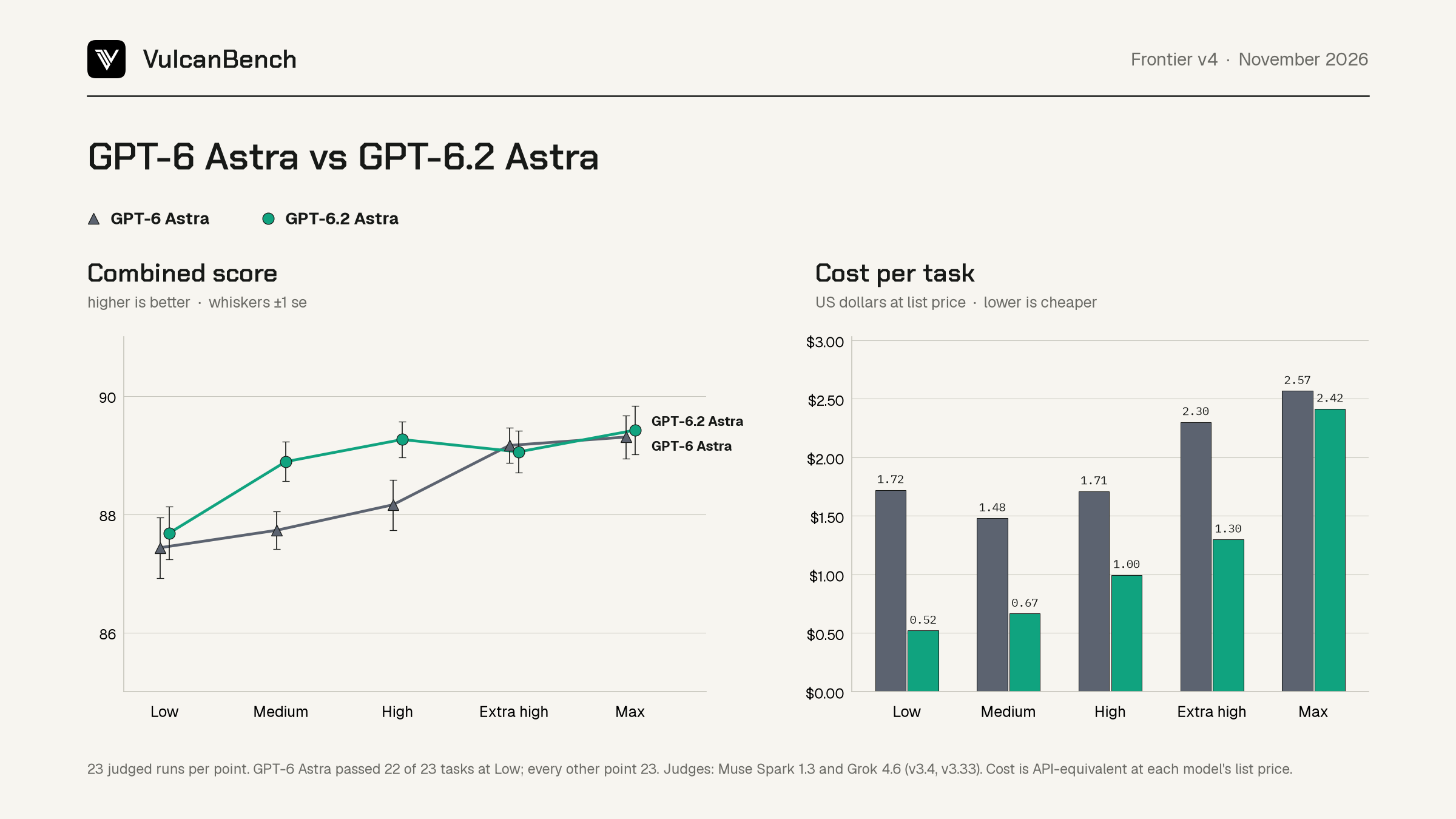
GPT-6.2 Astra gives what GPT-6 Astra gave for less money. It costs less per task at every level, about a third as much at Low and Medium, and passes every task at every level, where GPT-6 Astra missed one at Low. It scores above GPT-6 Astra at Medium and High and level with it at Low, Extra-high and Max. Its judges rate its code a little below GPT-6 Astra’s at every level; its gains come from the lint and security scans. Medium, at $0.67 and 2.4 minutes a task, is within 0.53 points of its best. These runs compare a model-and-harness combination, not an isolated base model; the Frontier v4 leaderboard places every GPT-6.2 Astra level beside the other models.
Combined score and Code quality by effort
n=23 at every level. Combined (33%) is the published score. Combined (20% profile) applies the prior 50/15/15/20 weights to the same Code quality scores for comparison. Code quality, human readability, maintainability and intent recovery are out of 100 and equal means of the two judges. Passed counts all 23 runs. Runtime is solver wall-clock per task over every run in the cell.
| Model / harness | Effort | Combined (33%) | SE | Combined (20% profile) | Code quality | Human readability | Maintainability | Intent recovery | Judged | Passed | Min/task |
|---|---|---|---|---|---|---|---|---|---|---|---|
| GPT-6.2 Astra / Codex | Low | 87.68 | 0.44 | 90.77 | 67.27 | 57.6 | 69.2 | 77.6 | 23/23 | 23/23 | 1.7 |
| GPT-6.2 Astra / Codex | Medium | 88.89 | 0.33 | 91.61 | 70.65 | 62.4 | 71.8 | 80.1 | 23/23 | 23/23 | 2.4 |
| GPT-6.2 Astra / Codex | High | 89.26 | 0.31 | 91.42 | 72.88 | 64.6 | 74.8 | 81.4 | 23/23 | 23/23 | 3.6 |
| GPT-6.2 Astra / Codex | Extra-high | 89.05 | 0.36 | 91.01 | 72.98 | 64.9 | 75.3 | 80.8 | 23/23 | 23/23 | 5.7 |
| GPT-6.2 Astra / Codex | Max | 89.42 | 0.41 | 91.07 | 74.53 | 66.3 | 77.3 | 81.9 | 23/23 | 23/23 | 14.0 |
Every run is scored by both judges. Each judge’s primary review and intent probe of all 115 submissions is valid, so no run is scored by one judge and no run is unpublished. Sixteen calls needed the protocol’s one retry, described under judges and calibration; every retry was valid.
Four factors by effort. Functional correctness is 100.00 at every level; lint and complexity average 83.01, 85.81, 84.60, 84.16 and 83.54 from Low to Max; security 99.13, 97.39, 94.35, 91.96 and 90.87. The security scan (bandit) found no medium or high severity issue in any run. Its low-severity findings, which take a run to 0.9 (0.85 for Extra-high paddockcore), appear in 2 runs at Low, 6 at Medium, 13 at High, 18 at Extra-high and 21 at Max: the count grows with effort.
Intent recovery is scored over the specification departures a submission actually passed tests for. Every run passed at least one quirk family, so no run needed its intent points moved to the reviewed score. SE is one sample standard error of the combined score across the cell’s tasks. It describes task sampling, not judge uncertainty, repeated runs or a significance test. No solver fallback occurred, and neither judge produced a reviewer fallback on any of the 115 submissions.
Against GPT-6 Astra
GPT-6 Astra ran the same 23 tasks through Codex CLI 0.153.4 in September and was judged by the same two judges under v3.4. GPT-6.2 Astra scores 0.25 points higher at Low, 1.16 at Medium and 1.10 at High, 0.11 lower at Extra-high and 0.12 higher at Max. The Medium and High gains are more than two standard errors of either column; the other three differences are well inside one, so read those levels as level. GPT-6.2 Astra passes all 23 tasks at every level; GPT-6 Astra passed 22 at Low, where paddockcore fell short of a full pass, and 23 above.
It is cheaper at every level: $0.52 against $1.72 at Low, $0.67 against $1.48 at Medium, $1.00 against $1.71 at High, $1.30 against $2.30 at Extra-high and $2.42 against $2.57 at Max, at list rates a fifth lower than GPT-6 Astra’s for input and output and 60% lower for cached input ($8.00 against $10.00 input, $0.40 against $1.00 cached input and $40.00 against $50.00 output per million tokens). It is faster from Low to Extra-high (1.7 to 5.7 minutes a task against 3.8 to 8.1) and slower at Max (14.0 against 10.3), where it spends more tokens.
| Model / harness | Effort | Combined | SE | Judged | Passed | Min/task | Tokens/task | $/task | Code quality |
|---|---|---|---|---|---|---|---|---|---|
| GPT-6.2 Astra / Codex | Low | 87.68 | 0.44 | 23 | 23/23 | 1.7 | 0.36M | $0.52 | 67.27 |
| GPT-6 Astra / Codex | Low | 87.43 | 0.51 | 23 | 22/23 | 4.2 | 0.89M | $1.72 | 70.31 |
| GPT-6.2 Astra / Codex | Medium | 88.89 | 0.33 | 23 | 23/23 | 2.4 | 0.51M | $0.67 | 70.65 |
| GPT-6 Astra / Codex | Medium | 87.73 | 0.32 | 23 | 23/23 | 3.8 | 0.68M | $1.48 | 71.19 |
| GPT-6.2 Astra / Codex | High | 89.26 | 0.31 | 23 | 23/23 | 3.6 | 0.78M | $1.00 | 72.88 |
| GPT-6 Astra / Codex | High | 88.16 | 0.42 | 23 | 23/23 | 4.9 | 0.77M | $1.71 | 73.48 |
| GPT-6.2 Astra / Codex | Extra-high | 89.05 | 0.36 | 23 | 23/23 | 5.7 | 0.97M | $1.30 | 72.98 |
| GPT-6 Astra / Codex | Extra-high | 89.16 | 0.30 | 23 | 23/23 | 8.1 | 0.93M | $2.30 | 75.47 |
| GPT-6.2 Astra / Codex | Max | 89.42 | 0.41 | 23 | 23/23 | 14.0 | 1.31M | $2.42 | 74.53 |
| GPT-6 Astra / Codex | Max | 89.30 | 0.37 | 23 | 23/23 | 10.3 | 0.95M | $2.57 | 76.26 |
Code quality is the one measure where GPT-6.2 Astra does not gain: the judges rate it 3.04 points lower at Low, 0.53 at Medium, 0.59 at High, 2.50 at Extra-high and 1.73 at Max. Its combined lead comes from the two automated scans instead. The lint and complexity factor is 1.7 to 4.2 points higher at every level, and the security factor 5.4 to 11.7 points higher: GPT-6 Astra’s runs scored lower on the security scan at every level.
| Factor | Low | Medium | High | Extra-high | Max |
|---|---|---|---|---|---|
| Lint and complexity, GPT-6.2 Astra | 83.01 | 85.81 | 84.60 | 84.16 | 83.54 |
| Lint and complexity, GPT-6 Astra | 81.30 | 81.60 | 81.05 | 81.62 | 80.87 |
| Security, GPT-6.2 Astra | 99.13 | 97.39 | 94.35 | 91.96 | 90.87 |
| Security, GPT-6 Astra | 87.83 | 85.87 | 82.61 | 86.09 | 85.43 |
Read the comparison with its limits. Both columns are judged by Muse Spark 1.3 and Grok 4.6 under the same rubric, each in its own protocol run (v3.33 and v3.4); both judges retook the calibration exam in each. The two sweeps ran eleven weeks apart on different Codex CLI versions (0.166.0 and 0.153.4), so read the speed and token figures with that in mind. $/task is API-equivalent at each model’s list price from each run’s receipts; GPT-6 Astra’s figure is its central estimate, and its report also carries a long-context upper bound.
Beside GPT-6.2 Sol
GPT-6.2 Sol ran the same suite on the same Codex CLI build and ChatGPT plan five days earlier and was judged by the same panel under v3.31. The two are within half a point of each other from Medium to Extra-high; GPT-6.2 Sol is 0.76 points ahead at Low and GPT-6.2 Astra 0.68 ahead at Max. GPT-6.2 Astra’s Code quality is lower at Low and Medium and higher from High up, by 3.47 points at Max. GPT-6.2 Sol costs far less, $0.23 to $0.55 a task against $0.52 to $2.42, so GPT-6.2 Astra costs 2.0 to 4.4 times as much per task for at most 0.68 points. GPT-6.2 Astra is the faster of the two from Low to Extra-high and the slower at Max.
| Metric | Low | Medium | High | Extra-high | Max |
|---|---|---|---|---|---|
| Combined, GPT-6.2 Astra | 87.68 | 88.89 | 89.26 | 89.05 | 89.42 |
| Combined, GPT-6.2 Sol | 88.44 | 88.94 | 88.86 | 89.01 | 88.74 |
| Code quality, GPT-6.2 Astra | 67.27 | 70.65 | 72.88 | 72.98 | 74.53 |
| Code quality, GPT-6.2 Sol | 70.31 | 71.78 | 71.43 | 71.91 | 71.06 |
| $ per task, GPT-6.2 Astra | $0.52 | $0.67 | $1.00 | $1.30 | $2.42 |
| $ per task, GPT-6.2 Sol | $0.23 | $0.33 | $0.41 | $0.46 | $0.55 |
| Minutes per task, GPT-6.2 Astra | 1.7 | 2.4 | 3.6 | 5.7 | 14.0 |
| Minutes per task, GPT-6.2 Sol | 2.8 | 4.4 | 5.1 | 8.2 | 11.3 |
GPT-6.2 Sol’s report has its full record.
Cost and tokens across effort levels
All 115 runs priced from their Codex receipts at list API rates, cache-aware, with judging excluded. These are API-equivalent estimates, not subscription charges: GPT-6.2 Astra ran on a ChatGPT subscription, and what the plan bills is not observable from the receipts. Cost per task is $0.52 at Low, $0.67 at Medium, $1.00 at High, $1.30 at Extra-high and $2.42 at Max; the whole sweep comes to $135.69. Effort shows up in reasoning: the median run spends 0.1K output tokens on reasoning at Low and 21.2K at Max, and mean output rises from 2.7K to 30.7K tokens a task, while total tokens rise from 0.36M to 1.31M a task. Output is the dearest token at $40.00 per million, which is why Max costs nearly twice as much as Extra-high.
| Effort | Runs | $/task | Level total | Tokens/task | Output/task | Median reasoning | Cached share of input | Min/task | Median min |
|---|---|---|---|---|---|---|---|---|---|
| Low | 23 | $0.52 | $11.99 | 0.36M | 2.7K | 0.1K | 89.2% | 1.7 | 1.5 |
| Medium | 23 | $0.67 | $15.32 | 0.51M | 3.8K | 0.3K | 91.2% | 2.4 | 2.2 |
| High | 23 | $1.00 | $22.92 | 0.78M | 7.4K | 2.3K | 92.8% | 3.6 | 3.5 |
| Extra-high | 23 | $1.30 | $29.90 | 0.97M | 11.6K | 5.3K | 93.2% | 5.7 | 5.1 |
| Max | 23 | $2.42 | $55.56 | 1.31M | 30.7K | 21.2K | 92.6% | 14.0 | 13.9 |
| Full sweep | 115 | $1.18 | $135.69 | 90M | 10.5 h |
Pricing. Rates checked 2026-11-22 from OpenAI and the model page: GPT-6.2 Astra at $8.00 input, $0.40 cached input and $40.00 output per million tokens, standard tier, short context. Codex receipts report input, cached input, output and reasoning tokens per run, so cached input is billed at the cache-read rate and the rest at the standard rate; reasoning tokens are part of output and are not billed twice. OpenAI bills prompts over 272K input tokens at a higher rate, but Codex keeps each request within its context window, so no long-context premium is modelled, as for the other recent Codex columns. The sweep stamped each run at these rates at run time; the export recomputed every run from its receipt and matched every stamp.
Tokens are Codex’s raw totals, input (cached included) plus output; the full sweep row sums them over all 115 runs (Tokens/task in that row is the sweep total). Per-run estimates, token usage breakdowns and the rate table are in economics.json and runs.csv.
On the Frontier v4 board
GPT-6.2 Astra’s best level, Max at 89.42 ± 0.41 (n=23), ranks 23rd of the board’s 100 model and effort columns, one place above GPT-6 Astra’s best, Max at 89.30, and 0.0001 points behind Grok 4.7 at Low (89.4202 against 89.4201), a tie to two places. Among OpenAI columns only GPT-6.1 Terra at Max (90.00, 21st) ranks higher. By level it ranks Low 50th, Medium 32nd, High 25th, Extra-high 29th, Max 23rd. Of the 26 priced columns scoring 89 or more, GPT-6.2 Astra at High is the fourth cheapest, at $1.00 a task, after GPT-6.1 Terra at Max ($0.36), GPT-6.2 Sol at Extra-high ($0.46) and Claude Haiku 5.5 at Extra-high ($0.84). Max carries the best tag. The board’s critical effort suggestion picks Medium, within 0.53 points of the best for about a quarter of the cost and a sixth of the time, and its routine and rough suggestions pick Low. The leaderboard carries every column; GPT-6.2 Astra’s cells carry the ‡‡‡ footnote with its run conditions.
Read these placements with the panel in mind. GPT-6.2 Astra, GPT-6 Astra, GPT-6.2 Sol and most other columns are judged by Muse Spark 1.3 and Grok 4.6; Claude Fable 5.2’s, Grok 4.7’s, DeepSeek V4.1 Flash’s and Reflection Beam’s by Muse Spark 1.3 and GPT-6.1 Sol; Muse Wonder Full’s by Claude Opus 5.5 and GPT-6.1 Sol. Scores from different panels are not calibrated against each other, so gaps of a point or two between columns judged by different panels are not a reliable order.
What Code quality measures
Every judge receives the same rubric, frozen by hash before any review. It names the reader it scores for: an engineer who has never seen the code, reads it top to bottom without running it, and must make a correct change in one sitting. It tells the judge that its own ease at parsing dense code is not evidence of readability. Six dimensions are scored 0 to 4 in half steps against written anchors: naming, presentation and intent form the human readability sub-score; structure, changeability and verifiability form the maintainability sub-score. Every score must cite an exact excerpt from the code and a concrete consequence for that reader. The host computes the sub-scores; the judge does no arithmetic.
The 33 points have three designed layers. The reviewed panel carries 24 points. An intent-recovery probe carries 9: the judge, given only the specification and the code, lists where the code departs from the specification, and a separate call matches that list against a frozen answer key, over the departures the submission passed tests for. The third layer, measured maintenance, is designed for 12 points but is not yet built, so the pre-registered 24 plus 9 split is in force. Frontier Code quality is therefore the reviewed layer plus intent recovery, and it is never compared with Routine v1 Code quality, which is scored on a different suite and population.
| Component | Low | Medium | High | Extra-high | Max |
|---|---|---|---|---|---|
| Code quality | 67.27 | 70.65 | 72.88 | 72.98 | 74.53 |
| Human readability | 57.6 | 62.4 | 64.6 | 64.9 | 66.3 |
| Maintainability | 69.2 | 71.8 | 74.8 | 75.3 | 77.3 |
| Intent recovery | 77.6 | 80.1 | 81.4 | 80.8 | 81.9 |
| Runs with no intent denominator | 0 | 0 | 0 | 0 | 0 |
| Rated by Muse Spark 1.3 | 61.1 | 67.0 | 69.1 | 69.4 | 70.7 |
| Rated by Grok 4.6 | 65.7 | 67.2 | 70.3 | 70.7 | 72.8 |
| Standard error of Code quality | 1.11 | 0.98 | 0.96 | 1.01 | 1.15 |
Code quality climbs with effort, 67.27 at Low to 74.53 at Max, and both sub-scores climb with it: human readability from 57.6 to 66.3 and maintainability from 69.2 to 77.3. Human readability is the weaker sub-score at every level. Grok 4.6 is the higher rater at every level, by 4.5 points on the reviewed score at Low and by 0.2 to 2.1 points at the other levels. Per-run sub-scores from each judge are in runs.csv; the exact rubric, system text, probe and match instructions are in judge-protocols.json.
Judges and calibration
The scored panel is Muse Spark 1.3 (Meta) through the Muse CLI on its Standard tier, and Grok 4.6 (xAI) through the Cursor CLI at medium effort, with equal weight, the same settings and pinned Muse binary as under v3.24. Grok 4.6 ran through the Cursor CLI pinned to version 2026.10.01-e373342, the build every Grok 4.6 round since v3.23 used, with a digest of its version directory checked before every stage; Cursor had since updated itself to a newer build, which was not used. Neither lab is OpenAI. Every session is fresh, tools are disabled, the workspace is empty, model identity is checked per call from the CLI’s own records, and solver labels are withheld. Protocol v3.33 changes nothing in the rubric, controls, quirk keys, gates, repeats, seed, weights or judges from v3.24; it applies the protocol to this population. The owner chose this panel on November 23.
Before scoring a single submission, each judge reviews ten held-out programs that implement the same ledger specification: clear, compressed, compressed then auto-formatted, verbose with duplicated policy, needlessly abstracted, misleadingly commented, narrated with a comment on every line, a documented legacy quirk, an embedded instruction to give full marks, and hidden module state. Each program is reviewed five times in a seeded order. Twenty gates fixed in advance check that the judge sees the construct; a judge may miss at most one gate by at most half a point. Both judges retook the exam under v3.33 before any counted call; had either failed, the other would have published alone.
| Judge | Protocol | Calls | Result | Allowance used | Failing gates |
|---|---|---|---|---|---|
| Muse Spark 1.3 | code-quality-maintenance-v3.33 | 80 | passed | no | none |
| Grok 4.6 | code-quality-maintenance-v3.33 | 80 | passed | no | none |
Both judges passed all 20 gates without the one-gate allowance. Every gate value and control mean is in calibration.json.
The judges agree on the shape. Scored by one judge alone, the combined score would be (Muse or Grok) 87.15 or 88.21 at Low; 89.02 or 88.75 at Medium; 89.11 or 89.41 at High; 88.70 or 89.41 at Extra-high; 89.18 or 89.66 at Max. Either way the score rises from Low to Medium and changes little above. Each run’s single-judge figures are in runs.csv.
Under v3.33 each judge made 440 counted calls: 80 in calibration, 115 primary reviews, 5 repeats, 10 pairwise checks, 115 intent probes and 115 answer-key matches, all 440 of them selected. Muse needed a second attempt on 9 calls (seven unsupported excerpts, two JSON syntax errors) and Grok on 7 (six unsupported excerpts, one JSON syntax error), under the protocol’s single-retry rule; every second attempt was valid, so no call was marked invalid. No call stopped on a usage limit. Every Grok call reported the display label “Grok 4.6 Medium” for the pinned model id, where the frozen settings say “Cursor Grok 4.6 Medium”; the operator wrapper accepts the rename and records it on all 440 selected Grok calls. Neither judge produced a reviewer fallback. Judging ran in one window from November 23, 2026, 15:25 UTC, to November 24, 03:13 UTC. Every operator record is in judge-protocols.json.
How it was run
- The model. GPT-6.2 Astra through the Codex CLI as
gpt-6.2-astra. Codex does not report the serving model, so model identity is the model requested. - Codex CLI 0.166.0. Pinned by version from the install the GPT-6.2 Sol column used, signed in with a ChatGPT subscription, in
codex execwith Codex’sworkspace-writesandbox, network access off, user configuration ignored and no saved session. - The plan. The ChatGPT login reported plan
prolite, the plan GPT-6.2 Sol ran on; earlier GPT columns ran on ChatGPT Pro. The plan sets usage limits, not the model served, and no run waited on a usage limit. - Five levels. Codex takes low, medium, high, xhigh and max for GPT-6.2 Astra; the board’s Extra-high is xhigh.
- From a tagged run worktree. Every run ran from
bench/2026-11-22-gpt62-astra-frontier-v4, so every run summary carries a clean source block and records the frozen suite lock’s task hash. - No timeouts, no retries, no notices. Every run finished inside the flat 3-hour bound; the longest, Max quotacore, took 18.4 minutes. The sweep log shows each level complete on its first attempt, and no run printed a Codex warning.
- Where and how. The owner’s Mac, one task at a time, on November 23, 2026, from 02:08 to 12:38 UTC. Every integrity audit is clean: no web access, and no benchmark data or answer-key paths.
- What is pinned. The Codex CLI is pinned by version, but the sweep cannot pin what OpenAI serves under the model id.
- One attempt per task and level. Runs were not repeated, and effort labels are Codex’s own.
Evidence and reproduction
Public files contain all 115 run measurements, both judges’ six-dimension sub-scores and intent-recovery scores per run, the combined score from each judge alone, hidden behaviours fixed, integrity-audit verdicts, each run’s task hash, raw tokens and API-equivalent cost estimates per run, five aggregates, every calibration gate value, the exact judge protocol text, the call record with each retry’s cause, and source hashes. Each run’s Code quality is (0.24 × reviewed score + 0.09 × intent recovery) / 0.33, where both terms are the equal mean of the two judges. The combined score is 100 × (0.50F + 0.085Q + 0.085S + 0.33C / 100). The reproduction guide gives the public arithmetic checks and links the protocol document, the operations log, the decision record, the Codex adapter and the code in the harness repository.
No human rated anything; the scores are model judgment for a human reader, not human validation. Hash checks bind the export to frozen files; they do not prove that judges were unbiased or that no training overlap exists.
Withheld: raw prompts and responses, submitted patches and reconstructed sources, the quirk answer keys (they describe hidden-test behaviour), reviewer session identifiers and usage receipts, solver event streams (a structure-only redacted trace of every run, every agent message, command, file change and tool call with its timing, is public in vulcanbench-gpt62-astra-traces), and host binary paths. Summed solver time is 10.50 hours; judging is excluded.